
Intelligent Document Extraction at Scale: From Unstructured PDF to Structured Data
Batch OCR + LLM extraction pipeline with 98.7% accuracy, human review UI, and JSON export in under 3 seconds.

Executive Summary
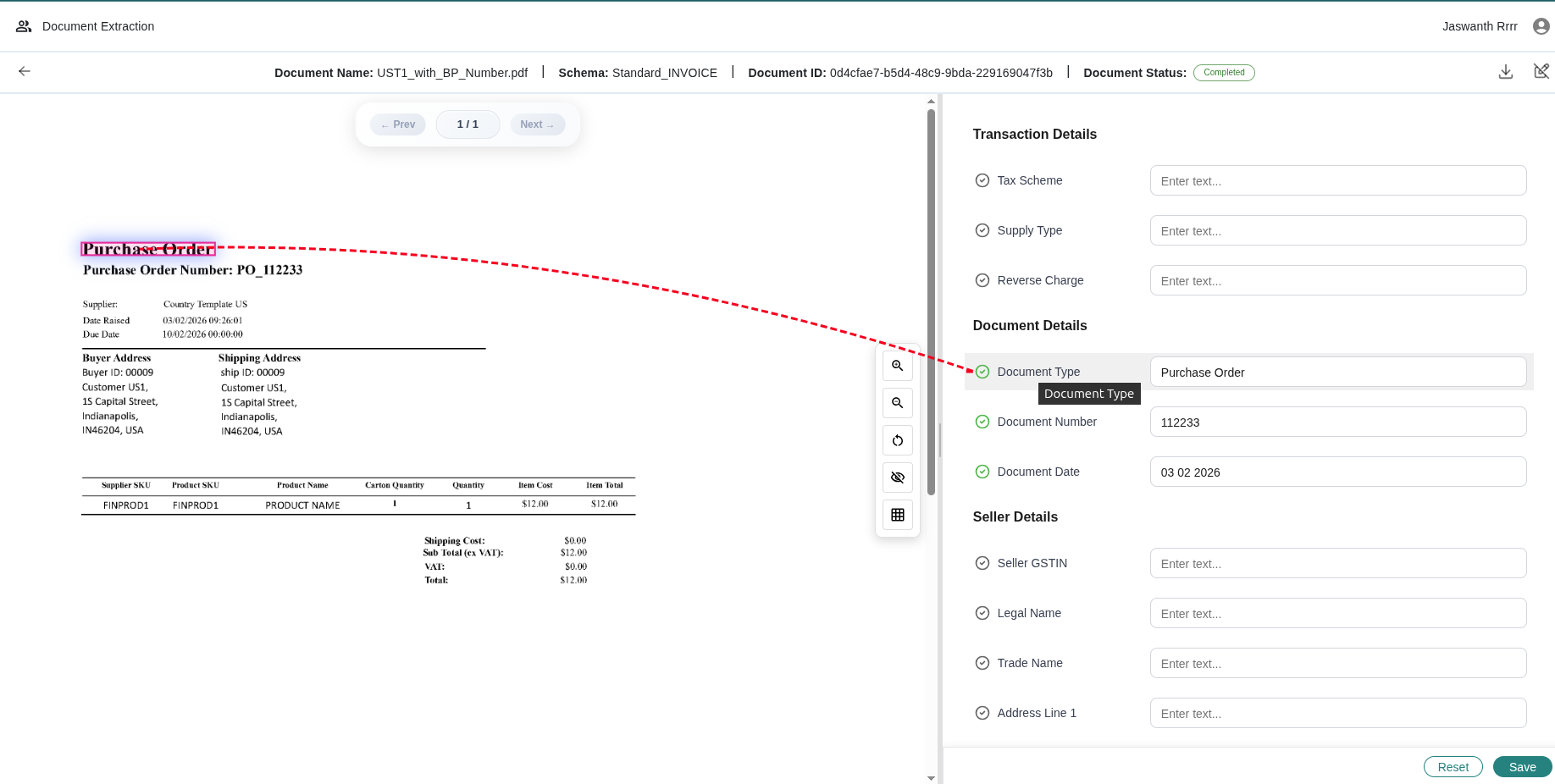
This article explores enterprise-grade intelligent document extraction across invoices, purchase orders, and compliance documents. It covers a five-stage pipeline: batch ingestion, page-to-image splitting at 300 DPI, multi-layer OCR with bounding box metadata, schema-guided LLM field extraction with per-field confidence scoring, and a human review UI with annotation overlays. The platform achieves 98.7% first-pass extraction accuracy with sub-3-second latency per page. Operators verify extracted fields via split-panel UI where red dashed annotation lines connect each value back to its source location on the document image. Validated results export to SAP DRC via RFC, REST webhook, UBL/XML for Peppol and ViDA, or direct JSON download. Business outcomes include 80% reduction in manual data entry, zero audit findings over 12 months, and a 9-month ROI payback period. The single platform handles 10M+ documents per month, eliminating point solutions and transforming document processing from a cost centre into a compliance advantage.
Key Focus Areas
- Five-stage extraction pipeline overview
- OCR layer & image pre-processing
- LLM schema-guided field extraction
- Human review UI & annotation overlays
- JSON export & SAP DRC integration
Pipeline Stages
- Batch document ingestion & schema tagging
- Page splitting & 300 DPI image rendering
- OCR with bounding box & confidence scoring
- LLM field extraction against target schema
- Human review, approval & structured export
Business Outcomes
- 98.7% first-pass extraction accuracy
- 80% reduction in manual data entry
- Sub-3-second latency per document page
- 10M+ documents processed per month
- Zero audit findings in 12 months

Key Implementation Challenges & Solutions
Building a reliable document extraction pipeline across diverse document types and quality levels introduces technical and operational hurdles. Here are two critical challenges and proven approaches to address them.
Challenge 1: Low-Quality Scans & OCR Accuracy
The Problem:
Scanned invoices and purchase orders often arrive skewed, at variable resolution, or with watermarks and fax artifacts. Naive OCR produces garbled tokens and missed fields, causing downstream LLM extraction failures and requiring full manual re-keying.
Recommended Approach:
Apply a pre-processing pipeline before OCR: automatic deskew via Hough transform, contrast and brightness normalisation, and watermark suppression. Emit per-token confidence scores so low-confidence regions fall back to the neural OCR pass and are flagged for LLM visual context rather than text context.
- Automatic deskew and rotation correction before OCR pass
- Contrast normalisation for fax-quality and low-resolution scans
- Per-token confidence scores surfaced to the LLM extraction stage
- Neural OCR fallback for tokens below confidence threshold
Challenge 2: Operator Trust & Review Efficiency
The Problem:
Operators reviewing hundreds of documents per day lose confidence when they cannot see where the system read a value from. Without clear provenance, teams default to full manual re-entry — eliminating the automation benefit entirely and introducing new keying errors.
Recommended Approach:
Surface bounding box coordinates for every extracted field in the review UI. Draw red dashed annotation lines from each extracted value on the right-hand panel to its exact origin on the document image on the left. Colour-code confidence levels and enable one-click bulk approval for high-confidence batches.
- Bounding-box annotation lines connecting extracted values to source image regions
- Confidence colour coding: green ≥ 95%, amber 80–94%, red < 80%
- One-click field override with automatic audit trail entry
- Bulk approve for high-confidence document batches
Conclusion
Intelligent document extraction is no longer a luxury reserved for large enterprises. The five-stage pipeline — ingest, split, OCR, LLM extract, review and export — collapses hours of manual effort into seconds of automated processing and seconds of human verification. Combined with SAP DRC integration and e-invoicing compliance workflows, the platform transforms document processing from a cost centre into a competitive advantage: faster close cycles, cleaner audit trails, and real-time visibility across every jurisdiction your business operates in.